The "Silent Phase" is Over: Why Psychological Safety is the Key to Language Fluency
Stuck in the "intermediate plateau"? Discover why fear of judgment holds language learners back and how "patient," low-stakes practice can unlock conversational fluency. Keywords: Language learning tips, foreign language anxiety, conversational fluency, pronunciation practice, AI language partner, overcome fear of speaking.
EDUCATION
12/20/20253 min read
Why Can I Read a Language But Not Speak It?
It is the most common frustration among language learners: You have a 500-day streak on a gamified app. You can read a menu in Paris or a train schedule in Tokyo. You understand the grammar rules.
But when a waiter asks you a simple question, you freeze.
This phenomenon is often rooted in Foreign Language Anxiety. It isn’t a lack of knowledge; it’s a fear of "losing face." As adults, we are terrified of sounding unintelligent. We dread the awkward silence after mispronouncing a word, or the embarrassment of accidentally saying something inappropriate because of a bad translation.
To move from "textbook smart" to "street smart," learners don't just need more vocabulary lists—they need psychological safety.
The nuance of "Je suis chaud" (and other embarrassing traps)
One of the biggest hurdles in fluency is the difference between literal translation and idiomatic reality.
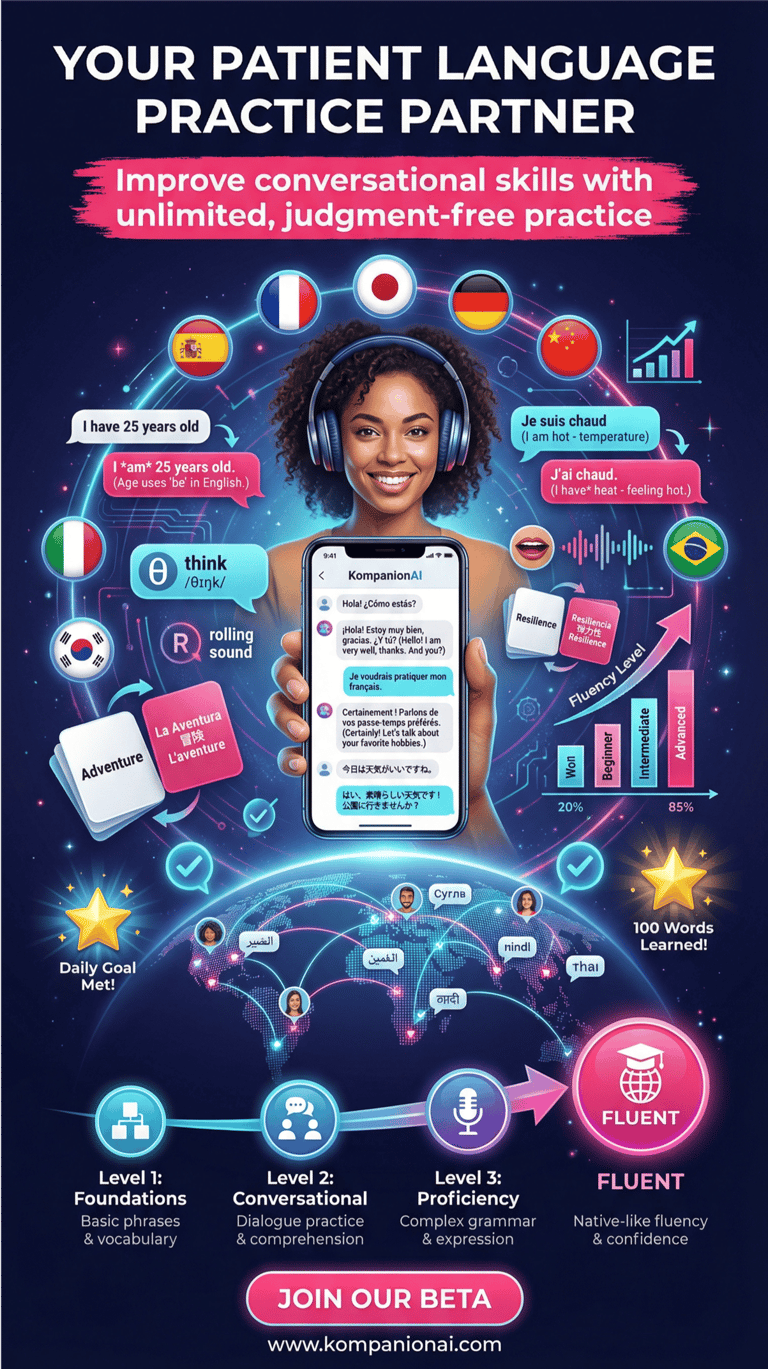
As highlighted in the infographic above, a direct translation often leads to awkward moments.
The Mistake: In English, we say "I am hot." If you translate that directly to French as "Je suis chaud," you are essentially telling people you are "feeling amorous" (or horny).
The Correction: The correct phrase is "J'ai chaud" (I have heat).
Another common error shown is the age structure. In English, we "are" an age ("I am 25 years old"). In Romance languages like Spanish or French, we "have" years ("I have 25 years").
These aren't just grammar points; they are confidence killers. When you make these mistakes in front of a busy native speaker, the embarrassment can make you retreat. To learn these nuances, you need a feedback loop that corrects you instantly but without judgment, allowing you to rewire your brain without the shame.
The Gym for Your Mouth: Rolling Rs and the "Th" Sound
Fluency isn't just mental; it's physical. Speaking a new language requires your tongue and lips to make movements they have never made before.
The "Th" (Theta) Sound: Common in English/Greek but a nightmare for many others.
The Rolling "R": Essential for Spanish/Italian but requires significant muscle memory.
You cannot learn these by reading. You learn them by doing them wrong 100 times until you do them right once. This requires a "Patient Practice Partner"—someone (or something) that will listen to you stumble over the same syllable for 20 minutes without getting bored or frustrated.
Breaking Out of the "Foundations" Trap
Looking at the roadmap in the visual above, most learners get stuck at Level 1: Foundations. They know basic phrases and vocabulary.
To jump to Level 2 (Conversational) and Level 3 (Proficiency), the input method must change. You have to stop consuming language (reading/listening) and start producing it (speaking).
This is where the concept of "Unlimited, Judgment-Free Practice" becomes vital. To reach the 85% fluency mark, you need to simulate immersion. You need to be able to switch contexts instantly—practicing ordering coffee one minute, and discussing the weather the next—without the pressure of a ticking clock or an hourly tutor fee.
How Technology is Changing the Conversation
While human tutors are invaluable for cultural depth, they aren't always available at 11 PM when you finally have time to study, and they can sometimes be expensive.
This is the functional role of tools like KompanionAI. It bridges the gap between static flashcards and real human interaction.
Immediate Feedback: It catches the "I have 25 years" error instantly, reinforcing the correct pattern before the bad habit sets in.
Cultural Context: It explains why a phrase is wrong, not just that it is wrong.
Endless Patience: It doesn't care if you need to practice the same sentence 50 times.
The Next Step in Your Journey
If you have been hiding behind flashcards because you're afraid to speak, it’s time to find your voice. Real fluency happens when you feel safe enough to make mistakes.
Whether you find a patient friend or use a digital partner, the goal is the same: Speak often, fail fast, and keep going.
Ready to practice without the pressure? KompanionAI acts as your patient, 24/7 language partner, helping you move from "beginner" to "fluent" with confidence. Join the Beta program today.
Connect
Have a Question?
Call
info@kompanionai.online
+1 513 273 0772
© 2025. All rights reserved.