Building Confidence: A Guide to Practicing Social Skills in a Low-Pressure Environment
An evidence-based guide to overcoming social anxiety by practicing social skills in low-pressure environments. Explore techniques from role-playing to AI-powered tools.
12/21/20252 min read
Practice Social Skills & Build Confidence: A Guide for Social Anxiety
Keywords: practice social skills, build confidence, social anxiety tips, overcome social anxiety, exposure therapy, social skills training, AI for social anxiety
For individuals living with social anxiety, the world can often feel like a stage where they are perpetually under a spotlight. The fear of judgment, of saying the wrong thing, or of simple awkwardness can be paralyzing, leading to avoidance of social situations that are crucial for personal and professional growth. The good news is that social skills, like any other skills, can be learned and improved with practice.
The key is to find a low-pressure, safe environment where the stakes are low and the freedom to experiment—and even to fail—is high. This article explores practical, evidence-based strategies for building your social confidence from the ground up.
The Principle of Gradual Exposure
One of the most effective therapeutic techniques for anxiety is exposure therapy, the principle of gradually and repeatedly exposing yourself to feared situations until they no longer trigger a fear response . For social anxiety, this doesn't mean jumping into a crowded party. It means starting small, in a controlled environment.
Practice Technique
Description
How to Implement It
Mirror Work
Practicing conversations with yourself in the mirror.
Rehearse introductions, practice telling a story, or work on maintaining eye contact with your reflection.
Role-Playing with a Trusted Friend
Enlisting a close friend or family member to act out specific social scenarios.
Practice a job interview, a first date, or navigating a disagreement in a supportive setting.
Journaling & Scripting
Writing out conversations or social scripts.
Before a social event, write down potential conversation starters, questions to ask others, and stories to share.
Online Communities
Engaging in text-based conversations in online forums or communities based on your hobbies.
This removes the pressure of face-to-face interaction while still allowing you to practice communication.
Leveraging Technology for Social Practice
In recent years, technology has opened up new and exciting avenues for social skills training. Virtual reality (VR) platforms, for example, are being used in clinical settings to simulate social environments. Another accessible and powerful tool is the AI companion.
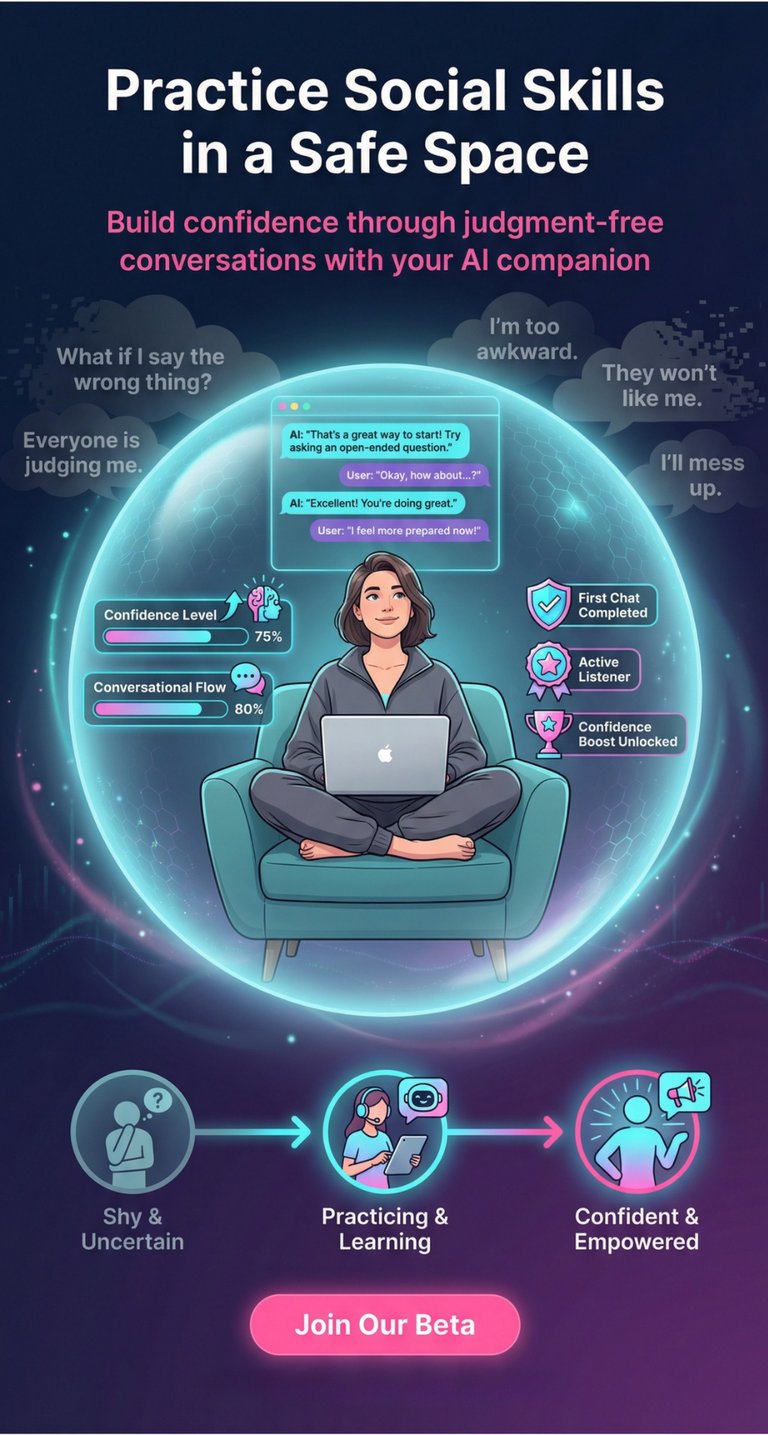
AI companions offer a unique practice ground: a conversational partner that is available 24/7, is completely non-judgmental, and has endless patience. You can:
•Practice Small Talk: Engage in light, everyday conversation to get comfortable with back-and-forth dialogue.
•Rehearse High-Stakes Conversations: Role-play a conversation with a boss or a difficult discussion with a friend, trying out different approaches.
•Get Immediate Feedback (in a sense): While not a therapist, the AI's response can help you gauge the flow of a conversation without any social risk.
Some newer platforms are designed with this use case in mind. For example, the KompanionAI project is building a companion that remembers your conversational goals and progress over time. This allows for a more structured practice, where you can build on previous sessions. The privacy-focused nature of such tools, where data is stored locally, also creates the psychological safety needed for genuine practice. If you're interested in trying this approach, their beta program is open at kai-m.bombshellapps.cloud.
The Goal: From Practice to Real-World Confidence
The purpose of practicing in a low-pressure environment is to build a foundation of confidence that you can carry into the real world. Start with the technique that feels most comfortable, and as you gain confidence, gradually increase the challenge.
Remember, the goal is not to become a perfect conversationalist—no one is. The goal is to become comfortable enough to connect with others authentically, to share who you are, and to feel a sense of belonging. Every small step in practice is a giant leap toward that goal.
References
[1] American Psychological Association. (2017). What Is Exposure Therapy?.
Connect
Have a Question?
Call
info@kompanionai.online
+1 513 273 0772
© 2025. All rights reserved.